


Why Standoff Distance Matters in Abrasive Waterjet Cutting
In abrasive waterjet cutting, small setup decisions can have a major impact on finished part quality. One of the most important—and often underestimated—variables is standoff distance, the gap between the nozzle tip and the material surface. When that distance is dialed in correctly, operators can achieve cleaner edges, better dimensional accuracy, and more consistent results. When it is off, even by a relatively small amount, shops may see poor edge finish, unwanted taper, rounded corners, and parts that fall outside tolerance.
For manufacturers and fabricators focused on precision, standoff distance is not just a setup detail. It is a core factor in process control. Whether cutting flat plate, warped material, beveled parts, or soft materials like foam, establishing and maintaining the proper nozzle height is essential for repeatable performance.
This article explores how standoff distance influences cut quality, how operators can program and control it in WARDJet software, and why advanced sensing solutions can make a measurable difference on the shop floor.
Understanding Standoff Distance in Waterjet Cutting
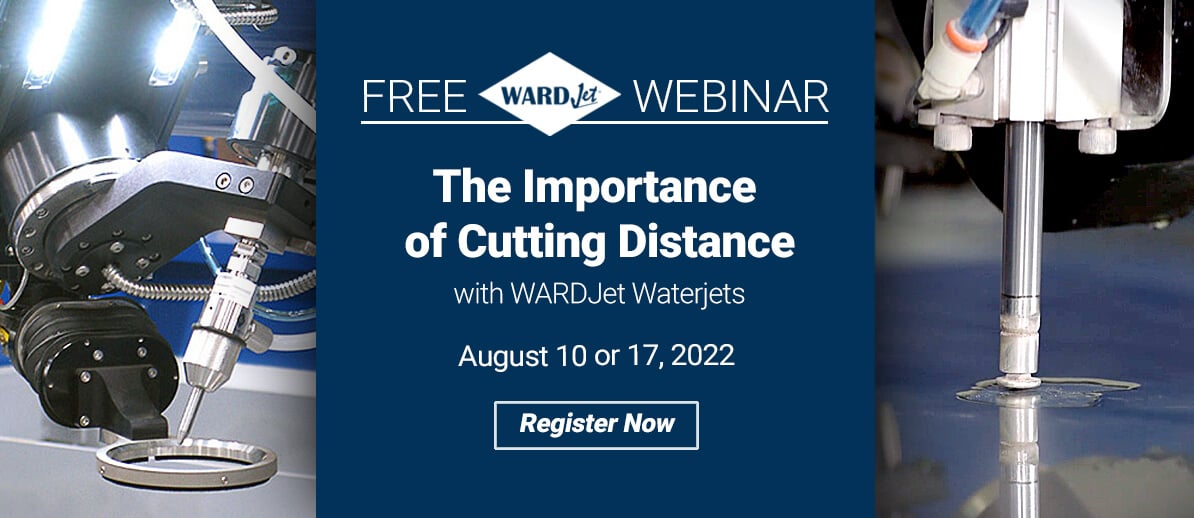
Standoff distance refers to the space between the waterjet nozzle and the top surface of the material being cut. In abrasive waterjet applications, that gap directly affects how the cutting stream enters the workpiece.
If the nozzle is positioned too high above the material, the jet has more room to spread before impact. That loss of focus can reduce cutting precision and lead to a wider top kerf, more pronounced taper, and a rougher or less uniform edge. If the nozzle is too low, the setup may become unsafe or risk contact with the workpiece, especially if the material is uneven or bowed.
The goal is to maintain the correct height consistently throughout the cut. This becomes especially important in production environments where shops need predictable quality across multiple parts, varying material conditions, and different geometries.
How Incorrect Height Impacts Cut Quality
Standoff distance affects several visible and measurable aspects of the finished cut:
Edge finish
A properly controlled nozzle height helps the stream enter the material cleanly, supporting a smoother edge appearance. Excessive standoff can create more edge rounding and reduce overall cut quality, especially on upper edge surfaces.
Taper
Taper is a common consideration in waterjet cutting. While taper is influenced by several variables—including speed, material type, thickness, and nozzle condition—standoff distance plays a direct role. Incorrect height can worsen taper and make parts less dimensionally accurate.
Dimensional accuracy
If the stream is less concentrated when it hits the material, the resulting cut path may not reflect the programmed geometry as accurately as intended. This matters for shops producing parts with tight tolerances or features that must fit precisely in downstream assembly.
Consistency
Even when one section of a part looks acceptable, inconsistency in material flatness or height can cause quality to vary from one region to another. Maintaining a stable standoff distance helps reduce variation across the entire cut.
Programming Height Control in WardCam and iGEMS
Modern waterjet operations depend on software not just for pathing, but also for process control. In WARDJet environments, operators can program height setters within WardCam and iGEMS to establish the desired cutting height before machining begins.
This is valuable because it takes standoff from being a manual judgment call and turns it into a repeatable part of the cutting program. By defining height settings in software, shops can standardize setup procedures, reduce operator-to-operator variation, and improve repeatability from job to job.
For manufacturers running a mix of materials and part designs, software-controlled height programming supports better process discipline. It also helps newer operators build good habits more quickly, since the setup procedure becomes embedded in the workflow rather than relying entirely on experience.
Manual vs. Automated Methods for Setting Height
There is still an important place for manual setup methods in waterjet cutting. For example, operators may use a gauge block or similar reference to manually establish nozzle height. This can be effective in certain applications and is often a useful way to verify or understand standoff settings.
However, automated height setting offers significant advantages in speed, consistency, and ease of operation. Machine-based automatic height setters reduce setup time and help ensure the programmed distance is achieved more reliably.
For busy shops, automation also reduces the chance of setup error. Instead of depending on a manual process each time a job is loaded, the machine can establish height with greater repeatability. That translates into less rework, fewer scrap parts, and more confidence that the first part will match expectations.
Handling Warped or Uneven Material
One of the biggest real-world challenges in waterjet cutting is that material is not always perfectly flat. Plate can bow, sheet can warp, and previously processed parts can have surface inconsistencies. Even if the nozzle height is correct at the start of the job, it may become incorrect as the cutting head moves across the workpiece.
This is where ride-along height sensors become especially valuable.
These sensors help the machine maintain a more consistent standoff distance as it travels over non-flat material. Instead of holding a fixed Z position while the material surface changes beneath it, the system can compensate for height variation and preserve cutting consistency.
That capability can have a major impact on part quality. Shops cutting warped sheet or plate often struggle with variable edge quality, taper changes, and dimensional shifts across the part. Height sensing helps reduce those problems by keeping the nozzle-to-material relationship stable even when the material itself is not.
Why Standoff Distance Is Critical in 5-Axis Bevel Cutting
The importance of standoff distance becomes even more pronounced in 5-axis bevel cutting. In these applications, the cutting head is angled to produce beveled edges, weld prep geometries, or more complex profiles. When the head tilts, the tool tip distance to the workpiece becomes even more sensitive.
If standoff is not controlled correctly during bevel cutting, the resulting geometry may be inaccurate. Bevel angles can shift, edge quality can deteriorate, and the cut may not match the intended profile. On sloped or uneven material, these issues become even more significant.
Proper standoff management in 5-axis work is therefore essential not only for surface finish, but for maintaining the correct bevel geometry. For fabricators producing weld-ready parts or precision bevel features, this can be the difference between a part that moves directly to assembly and one that requires secondary correction.
Best Practices for Water-Only and Foam Cutting
Although standoff distance is often discussed in the context of abrasive cutting, it also matters in water-only cutting and when processing soft materials such as foam.
These materials behave differently from metal plate, but nozzle height still influences cut quality and process stability. In foam cutting, for example, saving Z heights for repeat operations can improve workflow and help ensure consistent results across multiple parts. Different heights can produce noticeably different cut appearances, making proper setup just as important in soft material applications as it is in hard materials.
For shops expanding beyond traditional abrasive applications, understanding how height settings affect a wider range of materials can open the door to better quality and more reliable production.
Key Takeaways for Better Waterjet Results
Standoff distance is one of the simplest variables to describe, but one of the most important to control. It affects edge finish, taper, tolerance, and consistency across a wide range of waterjet applications. It also becomes increasingly important when cutting warped material, programming automated workflows, or producing bevel geometries in 5-axis work.
For operators and shop owners, the takeaway is clear: treating standoff distance as a controlled process parameter—not just a basic setup step—can lead to better parts and fewer production problems. With the right combination of software programming, automated height setting, and sensor-based compensation, shops can improve both accuracy and repeatability.
In a competitive manufacturing environment, those gains matter. Better setup control means better cut quality, less scrap, and a more capable waterjet operation overall.
👉 Learn more, request a demo, or get support from the WARDJet team:
https://www.wardjet.com/get-a-quote/