



How Work Offsets Improve Productivity and Repeatability on CNC Waterjet Systems
In any fabrication environment, consistency and speed matter just as much as cutting quality. Shops that rely on CNC waterjet systems often face a familiar challenge: how to position material accurately, run repeat jobs efficiently, and reduce setup time without sacrificing precision. When operators have to manually reposition the cutting head or re-establish part location for every cycle, productivity suffers and repeatability becomes harder to maintain.
That is where work offsets become a powerful tool.
By using work offsets such as G54, G55, and G59, manufacturers can create more repeatable workflows, simplify fixture-based cutting, and improve throughput across a wide range of applications. From repetitive blank processing to multi-sheet production and two-head cutting, offset-based programming helps waterjet users standardize cut locations and make better use of both machine time and operator time.
Why Work Offsets Matter in Waterjet Cutting
At a basic level, work offsets allow a CNC waterjet system to recognize different cutting locations relative to a programmed coordinate system. Instead of manually jogging the cutting head to a new position for every run, operators can save reference points and recall them as needed.
This approach offers a major advantage in production environments. Once a fixture or workholding setup is established, the machine can return to the same location repeatedly with minimal intervention. The result is a more reliable process, especially for shops producing the same parts over and over or managing multiple setups on one table.
For waterjet users, this matters because it improves:
- Repeatability from job to job
- Setup efficiency
- Operator productivity
- Fixture utilization
- Multi-part and multi-head workflow control
In short, work offsets help turn a waterjet system from a flexible cutting tool into a more efficient production asset.
G92 vs. G54-G59: Understanding the Difference
A key concept in offset programming is understanding how G92 differs from standard work offsets like G54 through G59.
G92 programming is often used to temporarily redefine a location in the machine’s coordinate system. While it can be useful in certain circumstances, it is generally less suited for repeatable, production-oriented applications because it tends to be more dependent on the current machine state and operator setup.
By contrast, G54-G59 work offsets are structured for repeatable reference positions. These offsets let operators store known cutting locations in the controller and reuse them consistently across jobs. That makes them especially valuable when a shop uses dedicated fixtures, processes recurring part families, or wants to run multiple zones on the same table.
For example, one offset might be tied to a fixture in the corner of the table, while another could reference a different material zone or head position. The programming stays organized, and the machine can move directly to the saved offset without repeated manual alignment.
Fixture-Based Cutting for Consistent Results
One of the most practical uses of work offsets is fixture-based cutting.
Fixtures allow operators to place blanks in a repeatable location, reducing variability and minimizing setup time between parts. Once a fixture is built and aligned, a work offset can be saved to match that exact position. From that point forward, parts can be loaded into the fixture and cut with far less manual intervention.
This is especially useful for manufacturers processing repetitive blanks, smaller part runs, or production jobs where consistency is critical. Instead of locating the material from scratch each time, the operator simply loads the blank into the fixture, recalls the saved offset, and starts the cycle.
That creates a workflow with clear production benefits:
Faster setup
The operator no longer needs to manually establish a new origin for each part.
Better repeatability
Each blank is cut from the same known reference point.
Reduced operator dependency
Consistent fixture placement lowers the risk of setup variation between shifts or personnel.
Saving Offset Positions in the Controller
To get the full benefit of work offsets, operators need to know how to save and manage offset positions in the controller. Once the fixture or material reference point is established, that location can be captured and assigned to an offset such as G54 or G55.
This creates a reusable positional reference that the machine can call up later. In practice, this means shops can build a library of offset locations for recurring production tasks. A fixture station, a foam cutting zone, a second head location, or a conveyor reference point can all be stored and reused.
This capability becomes even more valuable in mixed-production environments, where multiple part types or material setups may be used on the same machine. Instead of rebuilding coordinates for every job, operators can switch between saved offsets and keep production moving.
Adjusting Z Height for Material Thickness
Offset programming is not only about X and Y positioning. Z height also plays an important role, particularly when material thickness changes between runs.
When shops move from one thickness to another, the cutting height may need to be updated to maintain proper piercing and cutting performance. With work offsets, operators can adjust the Z value associated with the saved setup, helping ensure the machine is cutting at the correct height for the material being processed.
This is particularly important in applications involving different sheet materials, foam, or setups where the reference plane changes. By updating the offset rather than rebuilding the entire program, shops gain flexibility without losing efficiency.
Supporting Two-Head Cutting and Programmable Head Spacing
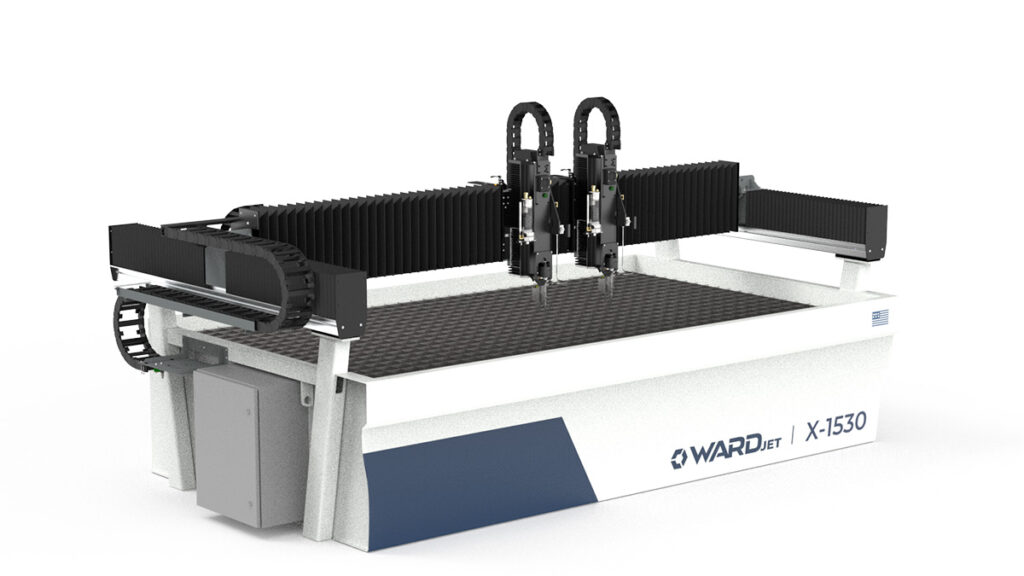
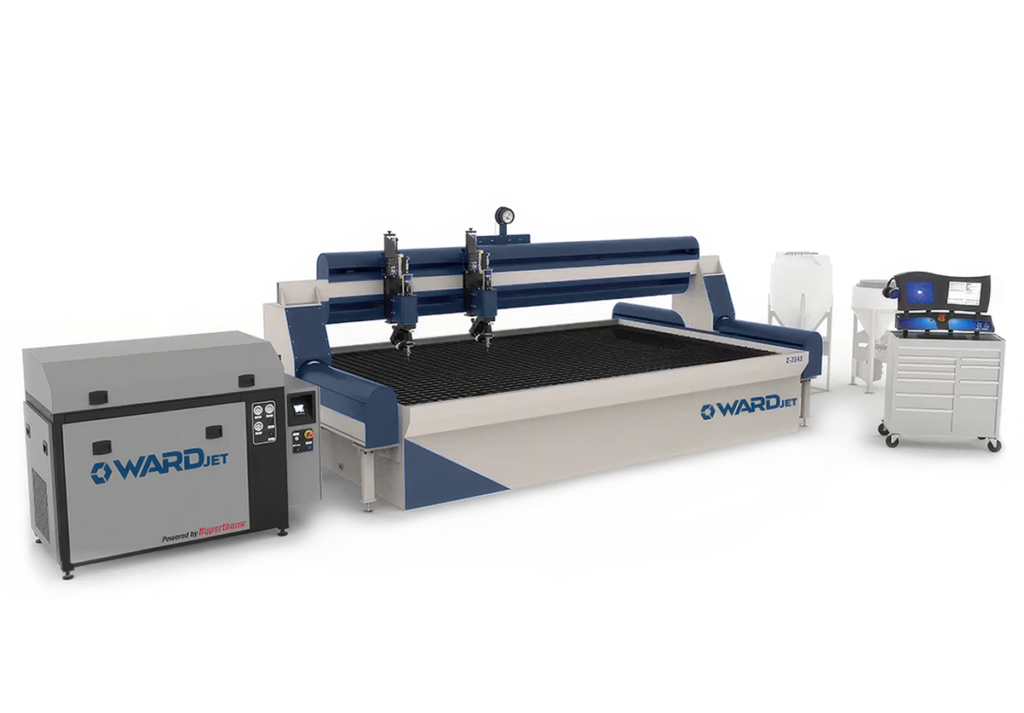
For shops running high-volume work, two-head cutting can significantly increase throughput. Work offsets play a major role in making those applications manageable.
By assigning offsets for each head or production zone, operators can control where cuts occur across the table and keep both heads aligned with the intended work area. This is especially useful when processing full sheets, mirrored production zones, or jobs that benefit from simultaneous cutting.
Programmable head spacing adds another layer of productivity. With newer controller software, operators can more easily manage the spacing between cutting heads and integrate that into offset-based workflows. This improves flexibility for wider part layouts, nested sheets, and applications where cut zones need to be adjusted without rewriting the entire job.
For manufacturers trying to maximize machine utilization, this combination of offsets and programmable head spacing can create a major operational advantage.
Nesting, Common Line Cutting, and Multi-Sheet Efficiency
Work offsets also pair well with modern programming strategies in software such as WardCam and IGEMS.
When creating offset-based files, programmers can design jobs that align with fixture positions, nesting layouts, and multi-sheet production strategies. Instead of thinking about one-off part placement, they can build files that are ready to run from predefined machine locations.
This is particularly effective for:
- Nested part layouts that maximize sheet usage
- Common line cutting strategies that reduce cut time and abrasive consumption
- Multi-sheet production runs where each zone is tied to a specific offset
- Repeat jobs where the same file is reused with little or no manual adjustment
These workflows reduce wasted motion, shorten programming-to-production time, and help ensure the machine is cutting from the correct location every time.
Expanding Offset Use Beyond Standard Sheet Cutting
Another advantage of work offsets is their versatility across machine types and applications.
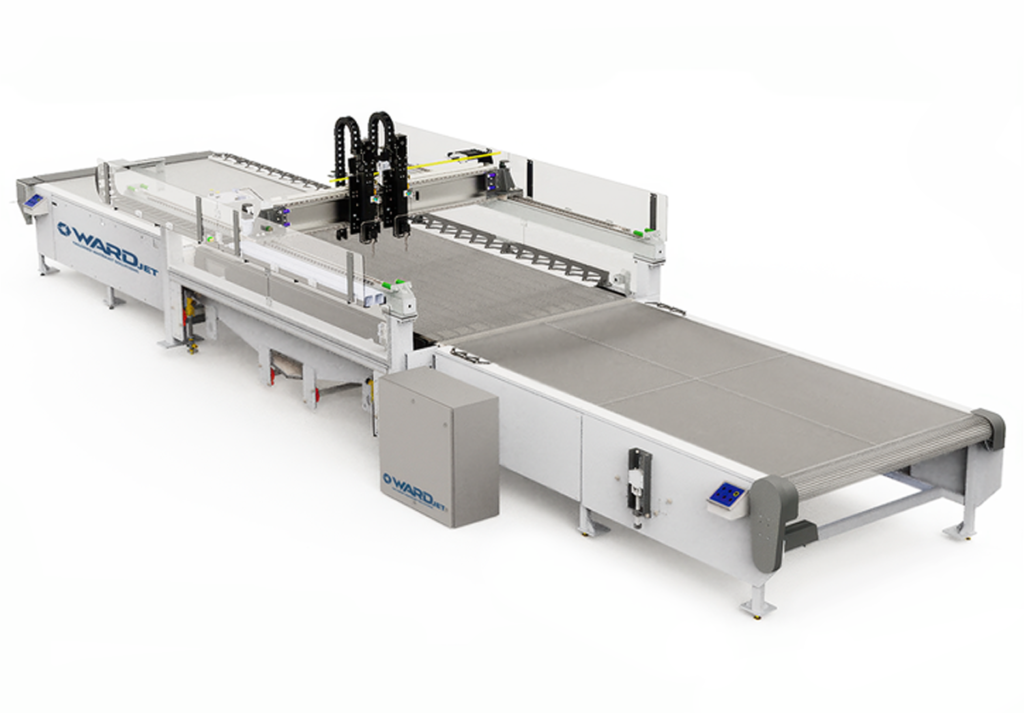
On water-only conveyor systems, offsets can help define cutting areas and support repeatable positioning for moving production environments. On table-based systems, offsets can establish different work zones for varying materials or processes. In advanced multi-head setups, they become even more important for coordinating capacity across the machine.
This makes work offsets relevant not only for traditional flat stock cutting, but also for specialized production cells where repeatable positioning is essential.
Key Takeaways for Waterjet Users
For engineers, fabricators, operators, and shop owners, work offsets offer a practical path to higher productivity. They help standardize setups, improve repeatability, and make advanced cutting strategies easier to manage.
The biggest advantages include:
- More efficient production for repetitive jobs
- Better integration of fixtures and workholding
- Faster setup and reduced manual positioning
- Easier adaptation to changing material thickness
- Improved support for two-head cutting and programmable head spacing
- Stronger software-to-machine workflow when using nesting and CAM tools
As waterjet systems continue to evolve, shops that make full use of controller features like G54-G59 offsets are better positioned to increase throughput without adding unnecessary complexity.
Moving Toward More Efficient Waterjet Production
Work offsets may seem like a programming detail, but in real-world manufacturing they can have a meaningful impact on day-to-day performance. They help turn repeat jobs into repeatable processes, reduce wasted motion, and give operators greater control over how parts are cut across the table.
For any shop looking to improve consistency, reduce setup time, and get more from its CNC waterjet system, offset-based programming is a smart step forward.
👉 Learn more, request a demo, or get support from the WARDJet team:
https://www.wardjet.com/get-a-quote/