


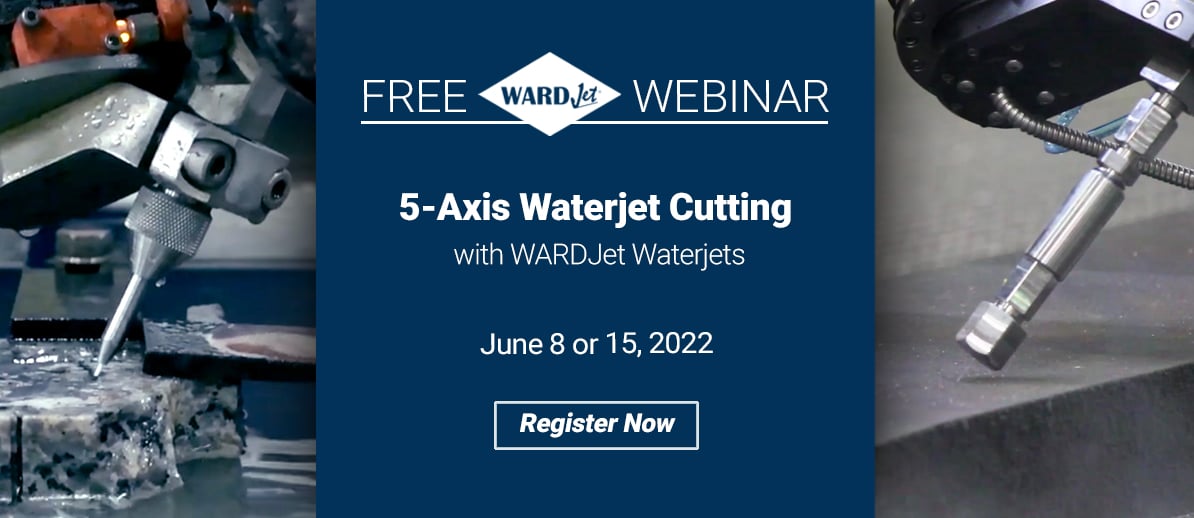
Moving Into Five-Axis Waterjet Cutting: What to Know About the Apex 60
Five-axis waterjet cutting opens the door to far more than straight-profile parts. For manufacturers producing beveled edges, weld-prep features, tapered geometries, and more complex fabricated assemblies, five-axis capability can dramatically expand what a waterjet system can do. But making the move into five-axis cutting is not just about adding a more advanced cutting head. It also requires a deeper understanding of machine design, programming strategy, calibration, and the real-world variables that affect part accuracy.
That is where the Apex 60 comes in.
Designed to give users greater control over bevel cutting and advanced geometry, the WARDJET Apex 60 five-axis cutting head helps fabricators and manufacturers take on more demanding applications with confidence. Understanding how it works—and how to program and maintain it properly—is essential for getting the most out of the technology.
Why Five-Axis Waterjet Cutting Matters
Traditional 2D waterjet cutting is ideal for producing flat parts with exceptional edge quality and no heat-affected zone. But many shops eventually reach a point where simple vertical cuts are no longer enough. Fabricated parts often require bevels for weld preparation, angled edges for assembly, or precise taper control for better fit-up and final part performance.
That is where five-axis cutting adds value.
With a five-axis head, operators can tilt the cutting stream to create top bevels, bottom bevels, and controlled taper angles. This enables shops to reduce secondary operations, improve weld readiness, and produce more complex components in a single setup. For industries focused on efficiency, repeatability, and precision, that can be a significant competitive advantage.
Apex 60 vs. the Infinity Winder: What Changed?
One of the first considerations when evaluating the Apex 60 is how it differs from the previous Infinity Winder design. While both are intended to support advanced waterjet cutting, the Apex 60 reflects design improvements aimed at delivering better functionality, easier usability, and stronger performance in modern five-axis applications.
For users familiar with earlier-generation systems, this comparison is important. Moving to a new head design is not only about hardware changes—it also affects programming behavior, calibration routines, and the way operators think about motion limits and toolpath strategy.
The Apex 60 is designed with these practical production realities in mind. It supports more sophisticated bevel and taper work while helping users manage common five-axis challenges such as axis limits, rewinds, and singularities. In other words, the hardware design and the programming workflow are tightly connected.
Accuracy in Five-Axis Cutting Starts Before the Cut
One of the biggest misconceptions about five-axis cutting is that accuracy depends only on the cutting head. In reality, part accuracy is influenced by several interconnected factors across the entire machine and process.
Table flatness
If the cutting table is not flat, the head may not maintain a consistent relationship to the material surface. In five-axis cutting, even small variations can affect bevel angle accuracy and edge quality.
Material flatness
Warped or uneven material introduces similar challenges. Since the cutting stream is being angled rather than kept strictly vertical, changes in material position can have a greater impact on the finished geometry.
Calibration
Five-axis systems must be calibrated carefully and consistently. Improper calibration can lead to dimensional inaccuracies, poor bevel angles, or inconsistent results from part to part. A machine may appear mechanically sound, but if calibration is off, the finished cut will reflect that.
Programming strategy
Even with a well-maintained machine, programming decisions play a major role in quality. Lead placement, part rotation, taper settings, and cut direction all influence the final result. Five-axis cutting requires operators and programmers to think beyond simple contour paths and consider how machine motion affects the cut from start to finish.
Smarter Programming for Better Five-Axis Results
Successful five-axis cutting depends on more than selecting a bevel angle and pressing start. Programming must account for how the cutting head moves, where the lead starts and ends, and how the machine transitions through complex geometry.
Bevel cuts and taper angle control
Programming top bevels and bottom bevels requires a solid understanding of how the toolpath interacts with the part geometry. It is not enough to define the angle alone. Operators also need to consider the direction of cut, lead-ins, lead-outs, and how taper angle control will affect the edge.
Taper angle control is especially useful when part consistency and fit-up are critical. By applying the proper settings and material database values, programmers can better manage edge geometry and produce more predictable results across varying materials and thicknesses.
Lead placement matters
Lead placement is one of the most important—and often overlooked—aspects of five-axis programming. Poor lead placement can create visible imperfections, interfere with critical edges, or force the machine into unnecessary rewinds.
With proper lead placement, operators can minimize interruptions and keep the toolpath smooth. This is especially important when cutting bevels, where motion strategy has a direct impact on cut quality and machine efficiency.
Avoiding rewinds and singularities
Rewinds and singularities are key concerns in five-axis cutting. A rewind occurs when the machine reaches a rotational limit and must reposition before continuing. A singularity happens when the head orientation creates a problematic or unstable condition in the toolpath.
Both issues can interrupt production and compromise quality if not handled correctly. The solution often comes down to better programming decisions, including smarter lead placement and strategic part rotation. By planning the part orientation in advance, programmers can often avoid these trouble spots entirely.
Practical Workflow in WARDCam and the Gems Five-Axis Package
A major advantage for users is the ability to program five-axis work through familiar software tools such as WARDCam and the Gems five-axis package. These workflows make it easier to move from part design to production while addressing the unique demands of bevel and taper cutting.
In WARDCam, operators can program bevel cuts, manage taper settings, and build efficient toolpaths for common five-axis applications. This provides a practical entry point for shops that want to begin using five-axis capabilities without overcomplicating the process.
For more advanced parts, the Gems package extends those capabilities further. Complex bevel geometries, multiple toolpath adjustments, simulation, and problem-solving around singularities can all be handled more effectively in a workflow built for sophisticated five-axis motion.
This is especially valuable for shops producing parts that go directly into fabricated assemblies. When multiple beveled components must fit together cleanly, software precision becomes just as important as machine precision.
Height Setter, Stamping Radius, and Consistency on the Floor
Production consistency often depends on the smaller details that are easy to overlook. Features such as the height setter and stamping radius can have a meaningful impact on cut repeatability and setup quality.
The height setter helps ensure the machine references material position correctly, which is essential when working with angled cuts. A reliable height reference improves consistency across multiple parts and reduces the risk of variation caused by setup error.
Stamping radius and probe placement also play a role in maintaining predictable machine behavior. These settings influence how the system approaches and processes the part, particularly in more advanced five-axis applications where precision is critical throughout the toolpath.
For production teams, these are not minor settings—they are part of the foundation for repeatable, high-quality cutting.
From Complex Parts to Real Assemblies
The real value of five-axis cutting becomes clear when looking at finished applications. A strong example is the cutting of complex parts used to create a welded box assembly. Rather than treating bevel cutting as an abstract software exercise, this kind of demonstration shows how five-axis waterjet technology translates directly into fabrication results.
By cutting accurate bevels and controlled angles directly on the machine, shops can simplify downstream welding and assembly. Parts fit together more cleanly, prep time is reduced, and overall workflow becomes more efficient. That makes five-axis capability especially attractive for manufacturers producing structural components, welded fabrications, and custom assemblies.
Calibration: The Key to Long-Term Performance
No matter how capable the hardware and software may be, long-term success with five-axis cutting depends on calibration. A step-by-step calibration workflow is essential for maintaining the performance of the Apex 60 and ensuring the machine continues to deliver accurate results.
Calibration is not something to treat as a one-time task. It should be part of a routine process for validating machine performance, especially in environments where precision and repeatability are critical. When calibration is performed correctly, it supports better bevel accuracy, more reliable taper control, and stronger confidence in production output.
For shops investing in five-axis technology, this is one of the most important takeaways: advanced capability only delivers value when it is supported by disciplined setup and maintenance practices.
Key Takeaways for Shops Evaluating Five-Axis Cutting
For manufacturers, engineers, programmers, and operators considering five-axis waterjet capability, the Apex 60 highlights several important lessons:
- Advanced cutting performance depends on both machine design and programming strategy.
- Accuracy is influenced by table condition, material flatness, calibration, and software decisions.
- Proper lead placement and part rotation can help prevent rewinds and singularities.
- Tools such as WARDCam and the Gems five-axis package support both everyday bevel work and more advanced part geometries.
- Features like the height setter and consistent calibration routines help improve repeatability on the shop floor.
Five-axis waterjet cutting is a powerful step forward for shops that need more than straight 2D profiles. With the right equipment, workflow, and process discipline, it can reduce secondary operations, improve fabricated part quality, and unlock new manufacturing opportunities.
Final Thoughts
As fabrication requirements become more demanding, shops need cutting systems that can keep pace with complex geometry, tighter fit-up expectations, and more efficient production goals. The Apex 60 is built to help meet those demands, offering a practical path into five-axis cutting for teams that want to expand capability without sacrificing control.
Success, however, comes from more than hardware alone. It comes from understanding the relationship between machine design, software strategy, calibration, and production best practices. When those elements work together, five-axis waterjet cutting becomes a highly effective tool for producing precise, assembly-ready parts.
👉 Learn more, request a demo, or get support from the WARDJet team:
https://www.wardjet.com/get-a-quote/