


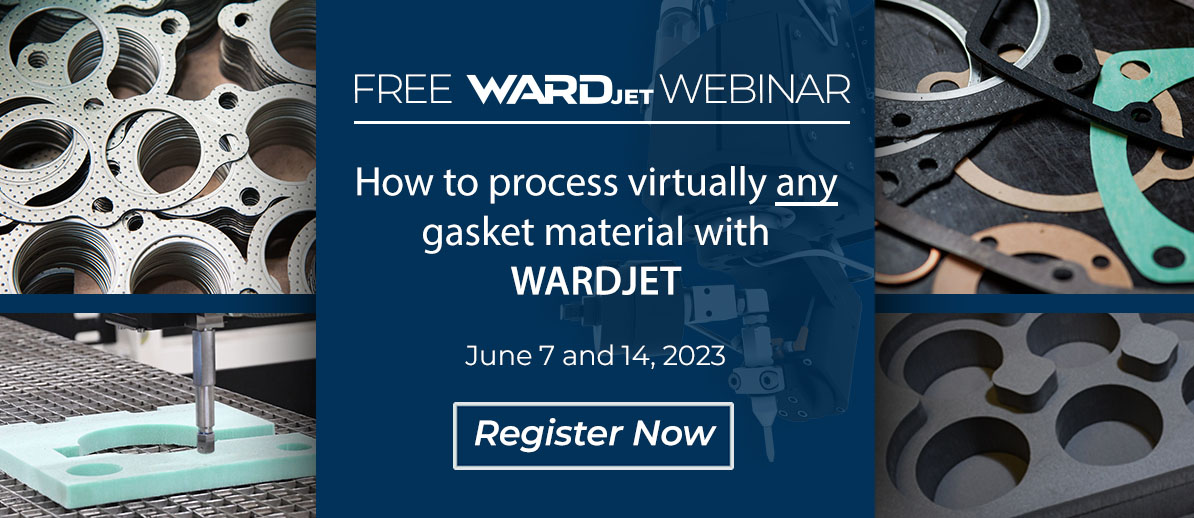
Waterjet Cutting for Gasketing Materials: From Prototype Parts to Automated Production
Gasket fabrication demands a cutting process that can handle soft, compressible, and often delicate materials without sacrificing precision. For manufacturers and fabricators working with compressed fiber, cork, Mylar, silicone sponge, polyurethane foam, and similar materials, traditional cutting methods can introduce a range of problems—from deformation and frayed edges to tooling costs and limited flexibility.
Waterjet cutting offers a different approach. By using either pure water or abrasive waterjet technology, shops can produce clean, accurate gasket components across a wide variety of materials while maintaining the adaptability needed for both custom jobs and full-scale production. Whether the goal is one-off prototyping, short-run manufacturing, or high-throughput automated processing, waterjet systems provide a versatile solution that aligns well with the realities of modern gasket fabrication.
Why Waterjet Cutting Fits Gasket Fabrication So Well
Gasket materials are often soft, layered, and sensitive to mechanical distortion. That makes them difficult to process with methods that rely on hard tooling, aggressive clamping, or heat. Waterjet cutting solves many of these issues by using a narrow stream to cut material cleanly without introducing heat-affected zones and with very little cutting force.
For gasket manufacturers, that translates into several practical advantages:
Minimal Material Deformation
Soft goods can shift, stretch, or compress during cutting. Waterjet technology reduces these risks by applying less physical force than many conventional cutting methods. This is especially valuable when working with foams, sponge materials, thin polymers, and flexible gasketing sheets.
Tool-Free Flexibility
Because waterjet cutting does not require dedicated hard tooling for every shape, shops can move quickly from one job to the next. This is ideal for manufacturers producing custom gasket profiles, low-volume specialty parts, or frequent design revisions.
Clean Edge Quality
Many gasketing applications depend on consistent edge quality for performance and fit. Waterjet cutting helps maintain accurate geometry while producing smooth, usable edges across a broad range of materials.
Broad Material Compatibility
One of the biggest advantages of waterjet processing is its ability to handle an extremely diverse material mix. A single system may be used for compressed fiber one day, silicone sponge the next, and harder composite or insert-containing materials after that.
Pure Water vs. Abrasive Waterjet: Knowing When to Use Each
A key part of successful gasket fabrication is understanding the difference between pure water and abrasive waterjet cutting.
Pure Water Cutting
Pure water cutting is often the preferred option for soft gasketing materials. It works especially well on materials such as:
- Silicone sponge
- Polyurethane foam
- Cork
- Mylar
- Compressed fiber in many cases
- Other soft nonmetallic sheet goods
Because no abrasive is introduced, pure water cutting is typically cleaner and well suited for soft materials that do not require extra cutting power. It is an efficient solution for many common gasket jobs and can support both simple and complex part geometries.
Abrasive Waterjet Cutting
Abrasive cutting becomes important when materials are harder, denser, or include rigid inserts that pure water cannot cut effectively. For example, gasket constructions with steel inserts or other reinforced elements may require abrasive to achieve a complete, high-quality cut.
This flexibility gives manufacturers a major advantage. Instead of limiting production to one class of material, they can match the cutting method to the application and maintain consistent output across a wider range of jobs.
From Standard Machines to Automated Production Systems
Waterjet cutting for gasketing is not limited to one machine style or production model. Different configurations support different levels of output, automation, and material handling.
Standard Cutting Systems for Flexible Production
For many fabricators, a standard waterjet platform provides the ideal balance of versatility and capability. These systems can handle everyday gasket cutting jobs, allow operators to switch materials quickly, and support prototype work or batch production without a complex setup.
This type of workflow is especially useful for job shops, contract manufacturers, and teams producing a variety of part sizes and quantities.
High-Throughput Automation with Dedicated Systems
As production volumes increase, automation becomes more important. Dedicated water-only systems and automated platforms are designed to streamline the flow of soft-material processing, especially in environments where speed, repeatability, and operator efficiency are priorities.
Automated production systems can support loading, material guidance, and batch workflows that reduce manual intervention and improve throughput. For gasket manufacturers producing high volumes of repeat parts, this can significantly improve consistency while helping control labor demands.
Programming and Nesting: Turning Designs into Production-Ready Parts
Cut quality is only one part of the process. Equally important is the software workflow that drives production.
In gasket fabrication, programming tools such as WARDCam, ProNest LT, and IGEMS play a critical role in converting part designs into efficient CNC cutting files. These platforms help operators move from concept to machine-ready production while optimizing material use and reducing unnecessary cycle time.
Part Programming
Programming software allows users to define part geometry, toolpaths, and processing parameters based on material type and cutting method. This is essential for maintaining accuracy and repeatability, particularly when working across different gasketing materials with unique behavior.
Nesting for Material Efficiency
Nesting is one of the most valuable capabilities in gasket production. By arranging parts strategically on the sheet, shops can maximize usable material and reduce scrap. This becomes even more important when cutting expensive specialty materials or running high-volume batches.
Common Line Cutting
For suitable parts and materials, common line cutting can further improve efficiency by allowing adjacent parts to share cut paths. This reduces cutting time and can increase throughput, especially in production environments where every incremental gain matters.
Material Database Management
Creating and refining material database entries helps standardize production. Once proper settings are established for specific gasket materials, operators can reproduce successful cutting conditions more reliably across future jobs.
Supporting Thin, Soft, and Stacked Materials
Material support is a major factor in successful gasket cutting. Soft and thin materials need stable backing and proper support surfaces to prevent movement during cutting.
Depending on the application, shops may use different support methods to accommodate thin sheets, delicate foams, or stacked material packs. Effective support improves cut consistency, reduces part movement, and helps preserve dimensional accuracy.
Stacking strategies are especially valuable when manufacturers need to increase throughput. By cutting multiple layers in a single cycle, shops can process more parts in less time. The key is matching stack height, material type, and cutting conditions to ensure clean separation and repeatable quality.
For operations evaluating waterjet for gasket work, this is an important point: the process is not just about the cutting head. Successful production depends on the full workflow, including support surfaces, nesting strategy, and batching methods.
Real-World Material Performance
One of the clearest strengths of waterjet cutting is its performance across common gasketing materials. Materials such as compressed fiber, silicone, cork, Mylar, and foam each present different cutting challenges. Some are prone to shifting, others compress easily, and some require more careful parameter control to maintain edge quality.
Waterjet technology provides a practical way to process this range of materials on one platform. For manufacturers handling diverse customer requirements, that versatility can reduce the need for multiple cutting technologies and simplify overall production planning.
It also gives teams a reliable path from prototype development to repeatable full-scale manufacturing, which is increasingly important in industries that demand both customization and speed.
Key Benefits for Manufacturers and Fabricators
For engineers, shop owners, operators, and production teams, the benefits of waterjet cutting for gasketing are clear:
- Greater flexibility across soft and rigid gasket materials
- Clean, accurate cuts with minimal deformation
- Efficient software workflows for programming and nesting
- Scalable production options from manual to automated systems
- Better material utilization through nesting and common line cutting
- The ability to handle both simple sheets and more demanding insert materials
In short, waterjet cutting supports a smarter, more adaptable approach to gasket manufacturing.
Final Thoughts
As gasket applications continue to expand across industries, manufacturers need cutting solutions that can keep pace with changing materials, tighter tolerances, and increasing production demands. Waterjet technology meets that challenge by combining precision, flexibility, and scalability in a single process.
From pure water cutting for soft goods to abrasive processing for harder inserts, and from basic sheet cutting to automated batch production, waterjet systems give fabricators the tools to improve efficiency without compromising quality. For shops evaluating how to modernize gasket production, it is a technology well worth serious consideration.
👉 Learn more, request a demo, or get support from the WARDJet team:
https://www.wardjet.com/get-a-quote/