


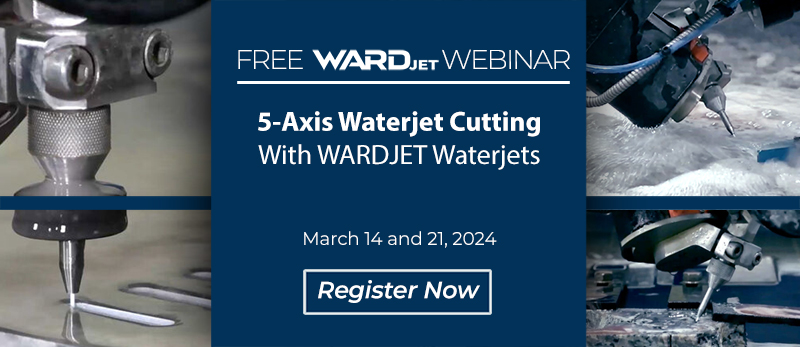
Mastering 5-Axis Waterjet Cutting: Fixture Design, CAM Strategy, and Real-World Setup with the Apex 60
Five-axis waterjet cutting opens the door to parts and profiles that are difficult—or impossible—to achieve with standard 2D cutting alone. But while the capability is powerful, success depends on much more than simply adding rotational motion to a cutting head. Fixture design, nozzle selection, work offsets, tool orientation, and CAM programming all play a direct role in whether a job runs smoothly or turns into a costly troubleshooting exercise.
For manufacturers, fabricators, and machine shops exploring advanced waterjet applications, understanding these fundamentals is essential. Complex bevels, angled cuts, intricate edge preparation, and multi-surface geometries all demand a more disciplined process than traditional flat cutting. The Apex 60 cutting head is designed to meet those challenges, but getting the best results requires a coordinated approach between machine setup and software strategy.
Here is a practical look at the key considerations behind successful 5-axis waterjet cutting and how shops can improve accuracy, repeatability, and cutting confidence from the first setup to the final part.
Why 5-Axis Waterjet Cutting Requires a Different Mindset
In conventional waterjet cutting, most of the focus is on part nesting, material handling, and basic path quality. In 5-axis cutting, the motion becomes more dynamic. The cutting head must reach into tighter areas, maintain proper stand-off, and rotate without colliding with fixtures or surrounding geometry. That means every decision upstream affects the outcome downstream.
This is why 5-axis cutting should be approached as a complete process rather than a simple machine function. Part quality is not determined by one setting alone. It is the result of how well the fixture is built, how the work offset is established, how the nozzle is configured, and how the CAM software accounts for clearance and motion.
For shops producing higher-value components, this process discipline translates directly into less scrap, fewer interruptions, and more predictable results.
Fixture Design: The Foundation of Accuracy and Repeatability
A strong 5-axis process starts with the fixture. When cutting complex features or angled profiles, the fixture is not just holding the part in place—it is establishing the entire reference system for the operation.
Poor fixture design can introduce movement, inconsistency, and positioning errors that become magnified once the cutting head begins rotating. Even small shifts in how a part is supported can affect dimensional accuracy, edge quality, and repeatability across multiple runs.
Well-designed fixtures help operators achieve several important goals:
Stable Material Support
The part must remain secure throughout the cut, especially when the head is approaching from different angles. Any vibration or instability can impact taper, kerf consistency, and final dimensions.
Reliable Alignment
Fixtures should make it easy to place material in the same location every time. Repeatable positioning reduces setup variability and simplifies offset management.
Access for the Cutting Head
Because 5-axis cutting involves head articulation, the fixture must provide enough clearance for the nozzle and cutting head to move without interference. A fixture that works for 2D cutting may not provide the required access for complex 5-axis paths.
In practice, prototyping fixture components before final production can be a smart move. It allows shops to validate fit, verify tool access, and refine the holding strategy before committing to a full production run.
Work Offsets and Z-Height: Small Setup Details, Major Impact
Once the fixture is in place, accurate work offset setup becomes critical. Establishing the G54 work offset correctly ensures that the machine references the part consistently and that programmed toolpaths align with physical reality on the table.
In 5-axis cutting, this matters even more because the machine is not only moving in X and Y. It is calculating angled motion and tool orientation relative to a known coordinate system. If the origin is off, the error compounds through the rest of the cut.
Z-height is equally important. The cutting head must maintain proper stand-off from the material surface to preserve cut quality and avoid contact issues. Incorrect Z settings can lead to inconsistent pierces, poor edge finish, or inaccurate bevel geometry.
Using a height-setting method to detect material position helps operators establish a more consistent cutting environment, especially when dealing with custom fixtures or irregular setups. This adds confidence before the full cutting program begins and reduces the risk of error at the machine.
Nozzle Length and Reach: Solving Tight Geometry Challenges
One of the most practical lessons in advanced waterjet cutting is that nozzle selection can dramatically affect access and performance. In many 5-axis applications, a standard nozzle configuration may not provide enough reach to cut around fixtures, access recessed features, or navigate tight part geometries.
A longer nozzle can solve these problems by extending the cutting stream farther from the head assembly, giving the machine more flexibility in confined areas. This added reach can be especially useful when cutting around tall fixtures or when the geometry requires the head to tilt into difficult positions.
However, changing nozzle length is not just a hardware swap. Controller settings and tool data must also be updated so the machine accurately understands the physical configuration of the tool. If those settings do not match the installed nozzle, positional accuracy and collision avoidance can be compromised.
This is a good example of how mechanical setup and software settings must work together. The longer nozzle may improve reach, but only if the machine and CAM system are configured to account for it correctly.
CAM Programming: Turning Complex Motion into Reliable Results
The leap from 3-axis to 5-axis cutting is where software becomes indispensable. Specialized waterjet CAM programming allows operators to create advanced toolpaths, assign tool orientation, simulate motion, and verify that the job is safe to run before sending it to the machine.
For shops adopting 5-axis capability, CAM software is not just a convenience—it is a necessity.
Fixture Integration and Collision Detection
One of the biggest advantages of modern 5-axis CAM software is the ability to bring fixture geometry into the programming environment. By importing fixtures and part setups into the CAM system, programmers can check for potential collisions before they occur on the table.
This is especially valuable when working with custom fixtures, taller part supports, or longer nozzles. A simulation that reveals interference early can prevent machine downtime, damaged tooling, or scrapped parts.
Toolpath Generation and Orientation Control
Generating a 5-axis toolpath involves more than selecting contours. Programmers must define how the tool approaches the cut, how it maintains stand-off, and how it rotates around the part. Orientation matters because an otherwise correct toolpath can still fail if the head tilts into a restricted area or approaches at the wrong angle.
Rapids and Safe Motion Planning
Non-cutting moves are another area where planning matters. Adjusting rapid movements and tool orientation between operations helps reduce the chance of interference. Safe, intentional motion planning is particularly important during first runs, where the goal is to verify the process without unnecessary risk.
Simulation for First-Run Confidence
Simulation provides a final validation step. Operators can visualize the cut, evaluate clearance, and test different nozzle configurations before running the program. Some shops may also use standoff adjustments during initial runs to create an added margin of safety while confirming setup accuracy.
Together, these tools give programmers and operators greater control over a demanding process and help turn complex part strategies into repeatable production routines.
Key Benefits for Advanced Waterjet Operations
When the setup and programming process is handled correctly, 5-axis waterjet cutting offers significant value to shops looking to expand capability.
The biggest advantages include:
- Greater flexibility for cutting angled and complex geometries
- Improved part quality through better control of tool orientation and stand-off
- Increased repeatability with strong fixture and offset strategy
- Reduced risk of collisions through simulation and fixture-aware programming
- Better access to tight or recessed features through optimized nozzle selection
These benefits matter across industries where precision, efficiency, and adaptability are essential. Engineers gain more design freedom. Programmers gain more control. Operators gain more confidence at the machine. Business owners gain access to higher-complexity work that can differentiate their shop in a competitive market.
Final Thoughts
Five-axis waterjet cutting is one of the most capable tools available for precision manufacturing, but its success depends on process discipline at every stage. Fixture design must support stability and access. Work offsets and Z-height must be established carefully. Nozzle length must match the geometry of the application. And CAM software must be used not only to create toolpaths, but to simulate, validate, and protect the operation before cutting begins.
For shops evaluating or already using 5-axis waterjet systems, the path to better results is clear: treat setup, tooling, and programming as one connected workflow. When those elements align, the Apex 60 becomes a powerful solution for producing accurate, repeatable, high-value parts in even the most demanding applications.
👉 Learn more, request a demo, or get support from the WARDJet team:
https://www.wardjet.com/get-a-quote/