


Robotic Waterjet Cutting: Where It Fits Best for High-Volume 3D Manufacturing
As manufacturers push for faster throughput, greater consistency, and more flexible automation, many are taking a closer look at robotic waterjet cutting. For the right applications, robotics can bring a powerful combination of repeatability, reach, and efficiency to waterjet processing—especially when parts are complex, production volumes are high, and manual operations create bottlenecks.
Robotic waterjet systems are not a one-size-fits-all solution. They shine in specific production environments, particularly where repetitive trimming, 3D cutting, and automated part handling are essential. From composite trimming to abrasive cutting of castings, robotic integration opens the door to new levels of productivity while also introducing important considerations around safety, programming, sound management, and cell design.
Understanding where robotic waterjet systems fit best—and how they differ from more traditional gantry-style machines—can help manufacturers make smarter automation decisions.
Why Manufacturers Are Turning to Robotic Waterjet Systems
Waterjet cutting is already valued for its versatility. It cuts without creating a heat-affected zone, handles a wide range of materials, and can produce clean, precise results across demanding applications. When robotics enter the picture, those benefits can be applied to parts and workflows that require more movement, more dimensional freedom, or more automation than a standard flatbed system can easily provide.
This is especially relevant in industries such as automotive, transportation, composites manufacturing, and industrial fabrication, where parts often have contoured surfaces, irregular geometries, or secondary handling requirements. In these cases, a robot can either guide the cutting head through a complex path or reposition the part beneath a stationary waterjet head.
The result is a system designed not just to cut material, but to fit into a broader automated manufacturing process.
Common Robotic Waterjet Applications
Robotic waterjet systems are particularly effective in high-volume, repetitive environments where 3D cutting or trimming is required. One of the most common use cases is water-only trimming, often used for softer materials or applications where abrasive is not needed. This is common in trimming formed materials, insulation products, interiors, and certain lightweight components.
For more demanding materials, abrasive robotic waterjet cutting provides the ability to cut through castings, composites, fiberglass, and other dense or reinforced materials. In manufacturing settings, this can support operations such as trimming molded fiberglass parts, processing composite components, or cutting weld test coupons from production samples.
These applications are often found in automotive and transportation manufacturing, where manufacturers need reliable, repeatable cutting performance on parts that are too complex or numerous for manual trimming to remain efficient.
When Robotics Are the Right Choice
One of the most important questions for any manufacturer is whether a robotic system is truly the best fit—or whether a gantry-style machine would be more practical.
In general, robotic waterjet cutting makes the most sense when the part geometry is three-dimensional, when the process benefits from multiple axes of motion, or when part handling itself is part of the automation strategy. If a part must be rotated, angled, or approached from multiple directions, a robot can offer flexibility that a traditional gantry system may not.
However, that flexibility comes with tradeoffs. Gantry-style waterjet systems are often better suited for flat parts, simpler cutting paths, and applications where maximum rigidity and straightforward programming are priorities. For purely 2D cutting, a gantry machine may be the more efficient and economical option.
The right decision depends on the application. Manufacturers should evaluate part shape, material type, volume requirements, cycle time expectations, and how the cutting process fits into the rest of the production cell.
Two Main Approaches to Robotic Waterjet Integration
There are two common ways to combine robotics with waterjet cutting, and each has its advantages.
1. Mounting the Waterjet Head on the Robot Arm
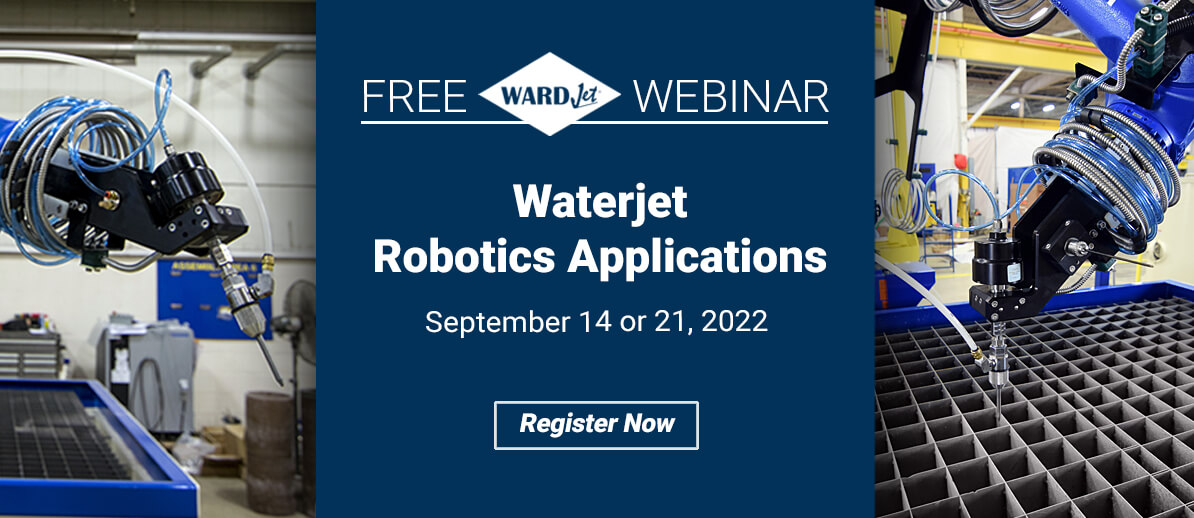
In this approach, the robot acts as the motion platform for the waterjet cutting head. This gives the system the ability to move the nozzle around the part, making it especially effective for trimming 3D shapes and reaching difficult contours.
This method is often attractive for applications where the part remains fixed and the cutting tool needs to move dynamically around it. It can provide excellent access to complex surfaces, but it also requires careful planning for hose routing, abrasive delivery, and robot payload considerations. Sound and splash containment become major design factors as well, since the cutting action is moving throughout the cell.
2. Using the Robot to Manipulate the Part Under a Stationary Cutting Head
In the second approach, the cutting head remains stationary while the robot picks up, rotates, or presents the part to the waterjet stream. This can simplify some aspects of abrasive delivery and waterjet plumbing, since the cutting head is fixed in place.
It is often a strong option for manufacturers who want greater control over cutting conditions while also automating part handling. In many cases, this design can reduce complexity around the cutting hardware itself while still allowing robotic motion to achieve the desired cut path.
The best choice depends on the size and weight of the part, the required cut geometry, and the overall goals of the production cell.
Cell Design Considerations That Matter
A robotic waterjet system is more than just a robot and a pump. Successful implementation depends on thoughtful cell integration.
Safety and Enclosures
Safety is one of the first priorities in any robotic waterjet application. High-pressure cutting demands proper guarding, enclosure design, and controlled access. Manufacturers must account for both robotic motion and waterjet hazards, including splash, ricochet, and high-pressure exposure.
Advanced solutions such as safe wall technology can play an important role in containing the process while maintaining operator protection. Well-designed enclosures also help reduce noise and improve the overall usability of the cell.
Sound Management
Robotic waterjet cutting can generate significant sound, particularly in abrasive applications. Because the cut point may move throughout the cell, acoustic management becomes an important design challenge. Enclosure materials, tank depth, and part positioning all affect the sound profile of the system.
Abrasive Delivery and Catcher Tank Design
In abrasive applications, delivery systems must be engineered to support consistent media flow while working within the robot’s motion envelope. Catcher tank design is equally important, particularly when cutting paths vary in position or orientation. The tank must safely absorb the jet’s energy while supporting clean operation and maintenance access.
Secondary Tooling and Pre-Drilling
Some parts require secondary operations such as pre-drilling or specialized fixturing to support the robotic waterjet process. These additions may be necessary to ensure accurate starts, better part presentation, or faster overall cycle times. A complete application review can identify where supplemental tooling will improve results.
Programming: Hand Guidance vs. Offline Simulation
Programming is another major factor in robotic waterjet success. Manufacturers generally choose between hand programming with a robot pendant and offline programming using simulation software.
Hand programming can be practical for simpler paths or lower-mix applications, especially during setup and development. It allows operators and technicians to teach motions directly at the robot, but it can become time-consuming for more complex parts.
Offline programming offers a more advanced workflow. Using simulation software, teams can build and verify cutting paths before they ever reach the production floor. This can reduce downtime, improve accuracy, and make it easier to manage complex geometries or frequent product changes. For many high-volume operations, offline programming becomes a key part of achieving repeatable and scalable performance.
The Real Value of a Custom Robotic Waterjet Cell
What separates a successful robotic waterjet installation from an average one is application-specific design. Every detail—from tray layout and operator interface to robot reach and fixture design—should support the actual production requirements of the user.
A well-designed cell does more than cut parts. It supports safe operator interaction, improves workflow, simplifies maintenance, and integrates into a broader manufacturing strategy. For companies evaluating robotic waterjet technology, the goal should not be simply adding a robot. It should be building a complete cutting solution that matches the realities of the process.
Key Takeaways for Manufacturers
Robotic waterjet cutting offers significant advantages for manufacturers dealing with high-volume, repetitive, and complex 3D applications. It is particularly valuable for trimming composites, fiberglass, and formed parts, as well as for abrasive cutting of castings and production samples.
At the same time, it requires careful evaluation. The right system architecture, programming strategy, safety design, and abrasive handling approach all have a direct impact on long-term performance. When matched to the correct application, robotic waterjet technology can deliver a strong return through improved consistency, reduced manual labor, and better integration with automated production environments.
👉 Learn more, request a demo, or get support from the WARDJet team:
https://www.wardjet.com/get-a-quote/