


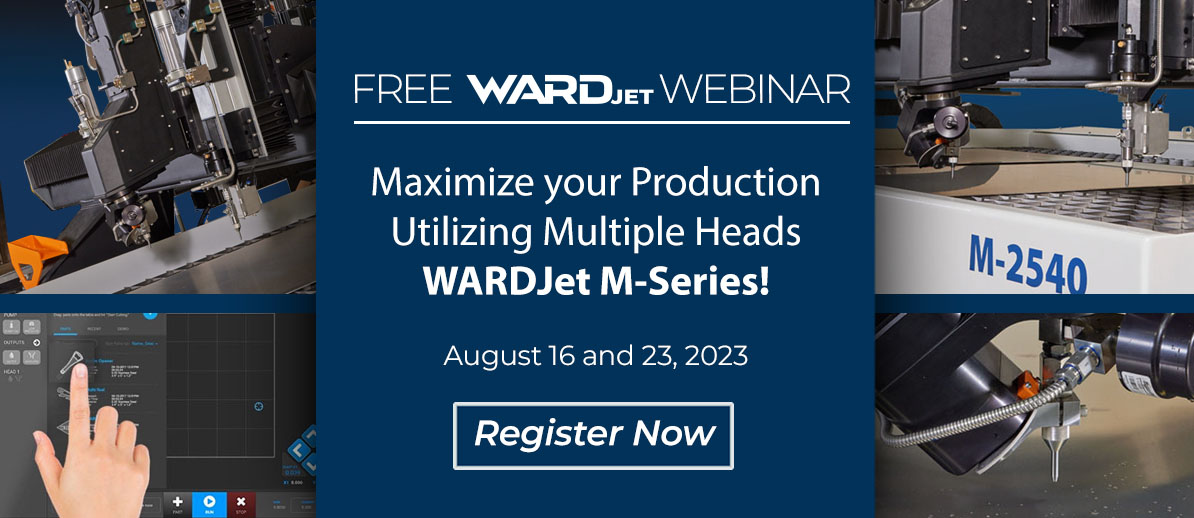
How Multiple Cutting Heads Boost CNC Waterjet Throughput Without Expanding Floor Space
Manufacturers are under constant pressure to produce more parts, shorten lead times, and control operating costs—all without endlessly expanding their shop footprint. For many fabrication businesses, that creates a difficult balancing act: how do you increase output without adding another machine, more floor space, or unnecessary complexity?
One of the most effective answers is multi-head waterjet cutting.
By equipping a CNC waterjet system with multiple cutting heads, manufacturers can increase throughput, improve workflow flexibility, and get more production value from a single machine platform. Whether the goal is to cut identical parts faster, handle different material and part layouts more efficiently, or optimize programming for higher yield, multi-head configurations can create a meaningful productivity advantage.
Here is a closer look at how multi-head cutting works, the machine configurations that support it, and the programming strategies that help manufacturers get the most from the system.
Why Multiple Cutting Heads Increase Productivity
At the most basic level, multiple cutting heads allow a waterjet system to cut more parts in less time. Instead of relying on a single head to complete each toolpath one part at a time, two or more heads can process multiple parts in parallel.
That has an immediate impact on throughput. If a shop is regularly producing repeatable parts in compatible layouts, adding cutting heads can dramatically increase output without requiring another machine on the floor. This is especially important for manufacturers who are constrained by available space but still need to scale production.
The benefit is not just speed. Multi-head cutting also creates more flexibility in how shops approach jobs. A manufacturer may use different head types—such as water-only or abrasive heads—depending on the application, material, or desired edge quality. That flexibility allows the machine to be adapted to a wider range of production requirements while keeping the process centralized on one system.
For fabricators balancing capacity, efficiency, and capital planning, multi-head cutting can be a practical way to do more with the assets they already have.
The Importance of Mechanical Accuracy
Adding more cutting heads only delivers results if the machine maintains the precision required to keep each head aligned and productive. Mechanical accuracy becomes especially important in multi-head systems because every head must follow the intended path with consistency.
If spacing, alignment, or motion control are not properly engineered, the result can be dimensional variation, poor edge quality, or inconsistent part output. That is why the mechanical design behind a multi-head waterjet system matters just as much as the concept itself.
WARDJET’s approach emphasizes the accuracy required for dependable multi-head performance. That includes the structural stability of the machine, the precision of carriage motion, and the ability to maintain head positioning across the full cutting area. For manufacturers, this is a critical consideration: more heads should multiply output, not multiply error.
When evaluating a multi-head solution, shops should look beyond simple head count and focus on how the full machine design supports repeatable accuracy under real production conditions.
Understanding Multi-Head Configurations
Not every shop has the same part mix, production schedule, or programming requirements. That is why multi-head waterjet systems can be configured in different ways depending on the application.
Master-Slave Setups
A master-slave arrangement is one of the most common and straightforward multi-head configurations. In this setup, one head acts as the lead, and the additional head or heads follow at a fixed spacing.
This is often a strong fit for production environments cutting identical parts in repeated patterns. Because the heads move together, the system can efficiently duplicate cuts across a sheet while keeping programming relatively simple. For shops producing batches of similar components, master-slave setups offer a clear path to higher throughput.
Spreader Bars and Adjustable Head Spacing
Spreader bars introduce more flexibility by allowing adjustable spacing between heads. This makes it easier to match head placement to the actual part layout, material width, or nesting arrangement.
That adjustability is valuable when part sizes vary or when shops want to optimize how much material is used in each run. Instead of being locked into one fixed spacing, operators can set the heads to better suit the job. This can improve efficiency while reducing waste and setup limitations.
Independently Controlled Carriages
For the highest level of flexibility, independently controlled heads allow each carriage to operate with more autonomy. This opens the door to advanced strategies such as mirrored motion, specialized toolpaths, and more adaptable cutting patterns.
Independent control is particularly useful when dealing with complex nesting scenarios, odd-shaped parts, or workflows that benefit from more than simple duplication. It gives shops the ability to tailor motion strategy to the material and the parts being cut, rather than forcing every job into a fixed arrangement.
For manufacturers with varied workloads, this level of control can be a major advantage.
Programming Strategies That Drive Better Results
Machine capability is only part of the equation. To fully benefit from multiple cutting heads, shops also need programming tools and strategies that support productivity.
In WARDCam, operators can program head spacing, manage tool selection, and define cut sequencing in ways that align with multi-head production. These functions are essential because the cutting strategy must reflect not only where the parts are located, but also how the heads interact across the job.
Proper cut sequencing can reduce unnecessary motion, improve consistency, and help maintain efficient production flow. Head spacing must also be programmed with accuracy so the system can reproduce the intended pattern across the material.
IGEMS adds another layer of optimization through capabilities such as multi-head nesting, common line cutting, roll material indexing, and zone detection.
Multi-Head Nesting
Multi-head nesting allows programmers to arrange parts in ways that maximize throughput while making efficient use of material. This is especially valuable when producing large quantities of similar parts.
Common Line Cutting
Common line cutting can significantly improve efficiency by allowing adjacent parts to share cut lines where appropriate. That reduces total cutting distance, lowers processing time, and can improve material utilization.
Roll Material Indexing
For manufacturers processing roll-fed material or long-format production runs, indexing support helps extend the practicality of automated multi-head cutting. It enables more consistent handling of continuous material workflows.
Zone Detection and Manual Toolpaths
Not every job is perfectly uniform. Odd part shapes, irregular nests, and mixed production layouts often require additional flexibility. Zone detection and manual toolpath tools help operators adapt the cut strategy to these less conventional scenarios, giving them more control over productivity when standard automation is not enough.
Planning for System Sizing and Operating Costs
A multi-head solution can create substantial gains, but it should be sized correctly for the application.
Manufacturers need to consider travel requirements, gantry mass, part sizes, and the type of work the machine will perform most often. A system configured for small repeat parts may look very different from one intended for large-format cutting or mixed-production environments.
Operating cost is another important factor. Shops often ask whether multiple heads automatically mean much higher operating expenses. The answer depends on how the system is used. While additional heads can increase consumable use during production, they also have the potential to improve output per square foot and reduce the need for additional equipment investment. In many cases, the productivity gains can justify the configuration when matched to the right application.
The key is to evaluate the entire production picture: part volume, material flow, programming demands, available space, and long-term capacity goals.
Key Benefits of Multi-Head Waterjet Cutting
When matched to the right workflow, multiple cutting heads can deliver several important advantages:
Higher Throughput
More parts can be cut in parallel, helping shops increase output without adding another full machine.
Better Use of Floor Space
Manufacturers can expand production capacity while keeping the footprint more compact.
Greater Flexibility
Different configurations support everything from simple duplication to advanced independent motion strategies.
Improved Programming Efficiency
Software tools in WARDCam and IGEMS help optimize spacing, sequencing, nesting, and cut strategy.
Scalable Productivity
A properly engineered multi-head system gives shops room to grow without immediately committing to more floor space or separate equipment.
Final Thoughts
For manufacturers looking to increase production without overcrowding the shop, multi-head CNC waterjet cutting offers a compelling path forward. From master-slave systems and spreader bars to independently controlled carriages, the right configuration can help improve throughput, increase flexibility, and make better use of both machine time and floor space.
Just as important, modern programming tools make it possible to turn that hardware advantage into real-world productivity. With the right strategy for head spacing, nesting, common line cutting, and toolpath planning, shops can unlock measurable gains across a wide range of applications.
For fabricators, engineers, shop owners, and production teams evaluating waterjet productivity improvements, multi-head cutting is more than a machine feature—it is a smart manufacturing strategy.
👉 Learn more, request a demo, or get support from the WARDJet team:
https://www.wardjet.com/get-a-quote/